
Beverage Manufacturing
Use-level, °Brix, acidity, flavor impact, dilution and process considerations for beverage manufacturing.
Read guide →Match fruit and vegetable ingredient formats to real manufacturing requirements. Explore how concentrates, NFC juices, purees, IQF frozen ingredients, powders and specialty formats behave in beverage, dairy, bakery, confectionery, prepared-food, foodservice and dry-blend production.
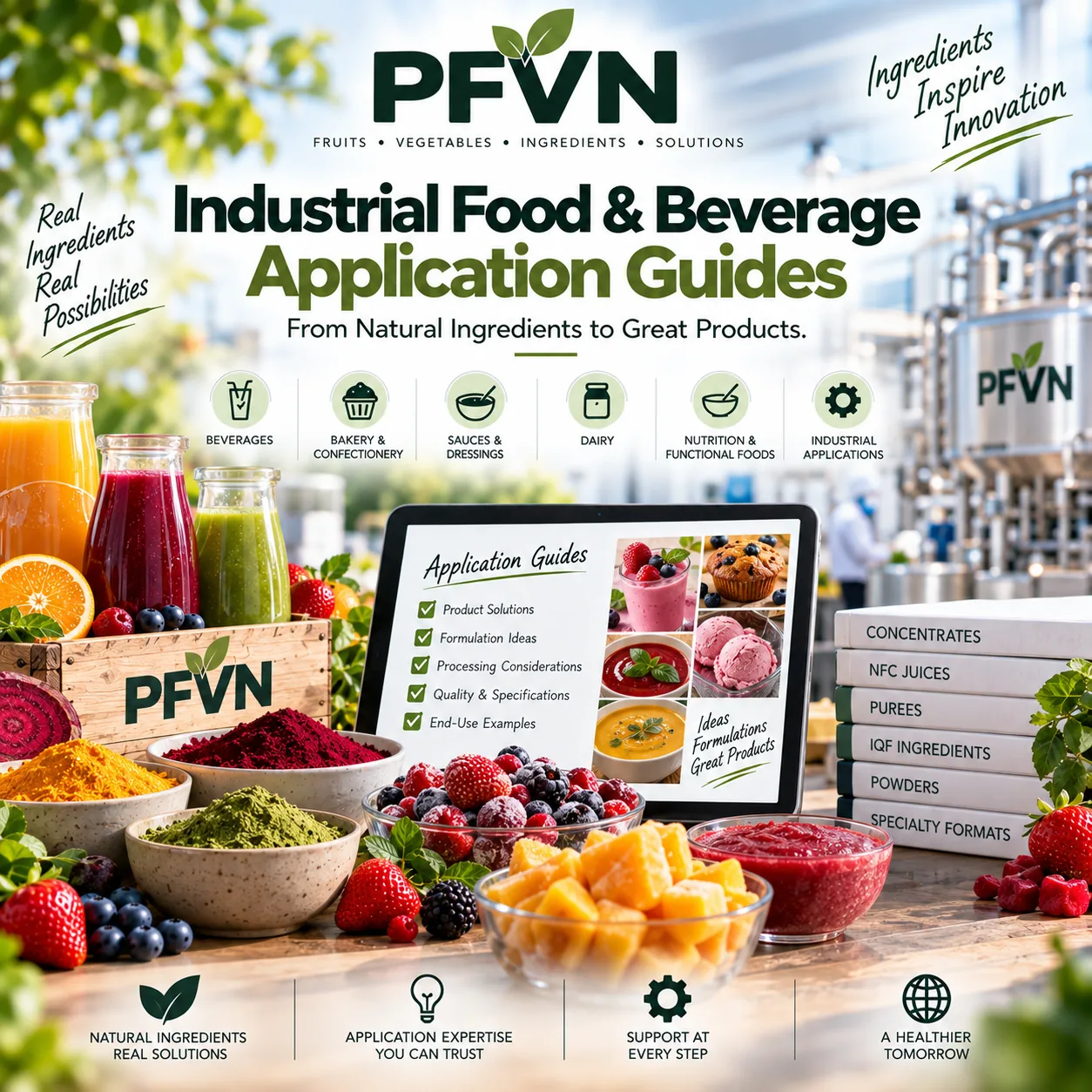
Fruit and vegetable ingredients are agricultural materials whose composition can vary with variety, maturity, crop season, origin and processing method. Industrial qualification should therefore connect the natural characteristics of the fruit or vegetable with the format supplied, the manufacturing process and the finished-product specification.
The same fruit may be supplied as concentrate, NFC juice, puree, IQF pieces, powder or another specialty format, and each form contributes differently to water balance, soluble solids, acidity, color, aroma, texture and handling. The application guides below help R&D, purchasing and quality teams define the attributes that should be controlled before commercial approval.
Evaluate fruit variety, °Brix or soluble solids, pH, titratable acidity, pulp or clarity, color, aroma, thermal history and microbiological requirements. Concentrates reduce transported water, while NFC formats retain a single-strength juice profile.
For purees, define viscosity, sieve or finish, seed and skin control, solids and sensory profile. For IQF fruits and vegetables, specify variety, cut size, piece integrity, defect tolerances, free-flow condition, thaw behavior and frozen storage.
Powders and specialty ingredients may require limits for moisture, water activity where relevant, particle-size distribution, carrier system, bulk density, dispersibility, color, flavor strength and moisture-barrier packaging.
A workable quotation also requires trial quantity, expected annual volume, preferred pack, certifications, origin requirements, storage condition, destination, delivery frequency and target timing. Crop seasonality and lead time should be considered during source approval.
Natural sugars, organic acids, pigments, aroma compounds, fiber, pectin, starch, seeds and cellular structure determine how a fruit or vegetable behaves when it is pressed, concentrated, pureed, frozen or dried. These characteristics influence formulation as well as pumping, heating, mixing, filling, freezing and storage stability.
°Brix is widely used for juices and concentrates as an indicator of soluble solids. It affects yield calculations, sweetness contribution, dilution ratios and formulation consistency, although it does not describe total solids in every ingredient format.
pH and titratable acidity influence flavor balance and can be important to process design. They should be specified separately when relevant because they measure different characteristics of the fruit or vegetable system.
Natural fiber, pectin and starch can create body or viscosity in purees and prepared foods. Variety, maturity, refining and thermal history may alter consistency, so physical specifications should use a defined test method.
Anthocyanins, carotenoids, chlorophyll and other natural pigments respond differently to oxygen, heat, light and pH. Approve color after the intended process when appearance is important to the finished product.
Variety, ripeness and processing determine characteristic flavor and aroma. Commercial approval should include sensory evaluation of representative lots under production-relevant conditions.
Agricultural variation cannot be managed by product name alone. Where consistency is critical, define measurable analytical, physical and sensory tolerances and qualify alternate origins or crops through the same process.
A useful industrial specification links incoming ingredient properties to finished-product performance. Exact limits vary by fruit, format and application, but the specification should clearly state the test method, units and acceptance range for every controlled parameter.
Use-level, °Brix, acidity, flavor impact, dilution and process considerations for beverage manufacturing.
Read guide →Use-level, °Brix, acidity, flavor impact, dilution and process considerations for fruit juice & nectar production.
Read guide →Use-level, °Brix, acidity, flavor impact, dilution and process considerations for soft drinks & carbonated beverages.
Read guide →Use-level, °Brix, acidity, flavor impact, dilution and process considerations for functional beverage formulation.
Read guide →Use-level, °Brix, acidity, flavor impact, dilution and process considerations for energy drink manufacturing.
Read guide →Use-level, °Brix, acidity, flavor impact, dilution and process considerations for sports & hydration drinks.
Read guide →Use-level, °Brix, acidity, flavor impact, dilution and process considerations for kombucha production.
Read guide →Use-level, °Brix, acidity, flavor impact, dilution and process considerations for brewing & craft beer.
Read guide →Use-level, °Brix, acidity, flavor impact, dilution and process considerations for hard cider production.
Read guide →Use-level, °Brix, acidity, flavor impact, dilution and process considerations for winemaking.
Read guide →Use-level, °Brix, acidity, flavor impact, dilution and process considerations for distilled spirits & fermentation.
Read guide →Use-level, °Brix, acidity, flavor impact, dilution and process considerations for syrups & cordials.
Read guide →Use-level, °Brix, acidity, flavor impact, dilution and process considerations for smoothie base manufacturing.
Read guide →Use-level, °Brix, acidity, flavor impact, dilution and process considerations for frozen beverage bases.
Read guide →Use-level, °Brix, acidity, flavor impact, dilution and process considerations for confectionery & gummies.
Read guide →Use-level, °Brix, acidity, flavor impact, dilution and process considerations for fruit snack manufacturing.
Read guide →Use-level, °Brix, acidity, flavor impact, dilution and process considerations for sauces & glazes.
Read guide →Use-level, °Brix, acidity, flavor impact, dilution and process considerations for bakery fillings & inclusions.
Read guide →Use-level, °Brix, acidity, flavor impact, dilution and process considerations for flavor systems & compounds.
Read guide →Use-level, °Brix, acidity, flavor impact, dilution and process considerations for foodservice beverage bases.
Read guide →Juice profile, pulp, acidity, heat treatment, storage and filling considerations for premium juice manufacturing.
Read guide →Juice profile, pulp, acidity, heat treatment, storage and filling considerations for juice blend production.
Read guide →Juice profile, pulp, acidity, heat treatment, storage and filling considerations for chilled beverage programs.
Read guide →Juice profile, pulp, acidity, heat treatment, storage and filling considerations for cold-filled beverage formulation.
Read guide →Juice profile, pulp, acidity, heat treatment, storage and filling considerations for cocktail & mocktail mixers.
Read guide →Juice profile, pulp, acidity, heat treatment, storage and filling considerations for sparkling fruit beverages.
Read guide →Juice profile, pulp, acidity, heat treatment, storage and filling considerations for wellness shots.
Read guide →Juice profile, pulp, acidity, heat treatment, storage and filling considerations for tea & juice beverages.
Read guide →Juice profile, pulp, acidity, heat treatment, storage and filling considerations for lemonade & limeade manufacturing.
Read guide →Juice profile, pulp, acidity, heat treatment, storage and filling considerations for craft soda formulation.
Read guide →Juice profile, pulp, acidity, heat treatment, storage and filling considerations for smoothie beverages.
Read guide →Juice profile, pulp, acidity, heat treatment, storage and filling considerations for fermented juice beverages.
Read guide →Juice profile, pulp, acidity, heat treatment, storage and filling considerations for kombucha with NFC juice.
Read guide →Juice profile, pulp, acidity, heat treatment, storage and filling considerations for dairy & cultured beverage flavoring.
Read guide →Juice profile, pulp, acidity, heat treatment, storage and filling considerations for plant-based beverage formulation.
Read guide →Juice profile, pulp, acidity, heat treatment, storage and filling considerations for kids beverage programs.
Read guide →Juice profile, pulp, acidity, heat treatment, storage and filling considerations for clean-label beverage programs.
Read guide →Juice profile, pulp, acidity, heat treatment, storage and filling considerations for foodservice juice programs.
Read guide →Juice profile, pulp, acidity, heat treatment, storage and filling considerations for private label juice manufacturing.
Read guide →Juice profile, pulp, acidity, heat treatment, storage and filling considerations for hospitality & institutional beverages.
Read guide →Viscosity, particle size, fruit solids, texture, thermal response and sourcing considerations for baby food manufacturing.
Read guide →Viscosity, particle size, fruit solids, texture, thermal response and sourcing considerations for fruit preparations for yogurt.
Read guide →Viscosity, particle size, fruit solids, texture, thermal response and sourcing considerations for ice cream & frozen desserts.
Read guide →Viscosity, particle size, fruit solids, texture, thermal response and sourcing considerations for smoothie & bowl bases.
Read guide →Viscosity, particle size, fruit solids, texture, thermal response and sourcing considerations for jams, preserves & fruit spreads.
Read guide →Viscosity, particle size, fruit solids, texture, thermal response and sourcing considerations for bakery fillings.
Read guide →Viscosity, particle size, fruit solids, texture, thermal response and sourcing considerations for dessert sauces & toppings.
Read guide →Viscosity, particle size, fruit solids, texture, thermal response and sourcing considerations for fruit leather & roll-ups.
Read guide →Viscosity, particle size, fruit solids, texture, thermal response and sourcing considerations for nutrition pouches.
Read guide →Viscosity, particle size, fruit solids, texture, thermal response and sourcing considerations for meal replacement foods.
Read guide →Viscosity, particle size, fruit solids, texture, thermal response and sourcing considerations for sauces & condiments.
Read guide →Viscosity, particle size, fruit solids, texture, thermal response and sourcing considerations for marinades & glazes.
Read guide →Viscosity, particle size, fruit solids, texture, thermal response and sourcing considerations for soups & culinary bases.
Read guide →Viscosity, particle size, fruit solids, texture, thermal response and sourcing considerations for dips & spreads.
Read guide →Viscosity, particle size, fruit solids, texture, thermal response and sourcing considerations for plant-based food formulation.
Read guide →Viscosity, particle size, fruit solids, texture, thermal response and sourcing considerations for confectionery centers.
Read guide →Viscosity, particle size, fruit solids, texture, thermal response and sourcing considerations for fruit bars & snack foods.
Read guide →Viscosity, particle size, fruit solids, texture, thermal response and sourcing considerations for pet food & treat manufacturing.
Read guide →Viscosity, particle size, fruit solids, texture, thermal response and sourcing considerations for foodservice dessert programs.
Read guide →Viscosity, particle size, fruit solids, texture, thermal response and sourcing considerations for prepared foods & ready meals.
Read guide →Cut size, piece integrity, defects, thaw behavior, frozen storage and handling considerations for industrial bakery & pastry.
Read guide →Cut size, piece integrity, defects, thaw behavior, frozen storage and handling considerations for smoothie manufacturing with IQF fruit.
Read guide →Cut size, piece integrity, defects, thaw behavior, frozen storage and handling considerations for dairy & yogurt inclusions.
Read guide →Cut size, piece integrity, defects, thaw behavior, frozen storage and handling considerations for ice cream inclusions.
Read guide →Cut size, piece integrity, defects, thaw behavior, frozen storage and handling considerations for foodservice fruit programs.
Read guide →Cut size, piece integrity, defects, thaw behavior, frozen storage and handling considerations for ready meal manufacturing.
Read guide →Cut size, piece integrity, defects, thaw behavior, frozen storage and handling considerations for frozen dessert manufacturing.
Read guide →Cut size, piece integrity, defects, thaw behavior, frozen storage and handling considerations for jam & preserve processing.
Read guide →Cut size, piece integrity, defects, thaw behavior, frozen storage and handling considerations for pie & bakery fillings.
Read guide →Cut size, piece integrity, defects, thaw behavior, frozen storage and handling considerations for retail IQF private label.
Read guide →Cut size, piece integrity, defects, thaw behavior, frozen storage and handling considerations for frozen yogurt toppings.
Read guide →Cut size, piece integrity, defects, thaw behavior, frozen storage and handling considerations for salads & prepared bowls.
Read guide →Cut size, piece integrity, defects, thaw behavior, frozen storage and handling considerations for fruit toppings & compotes.
Read guide →Cut size, piece integrity, defects, thaw behavior, frozen storage and handling considerations for snack pack manufacturing.
Read guide →Cut size, piece integrity, defects, thaw behavior, frozen storage and handling considerations for breakfast cereals & granola inclusions.
Read guide →Cut size, piece integrity, defects, thaw behavior, frozen storage and handling considerations for institutional & catering supply.
Read guide →Cut size, piece integrity, defects, thaw behavior, frozen storage and handling considerations for meal kit manufacturing.
Read guide →Cut size, piece integrity, defects, thaw behavior, frozen storage and handling considerations for soup & stew manufacturing.
Read guide →Cut size, piece integrity, defects, thaw behavior, frozen storage and handling considerations for sauce manufacturing with frozen vegetables.
Read guide →Cut size, piece integrity, defects, thaw behavior, frozen storage and handling considerations for pet food & treat applications.
Read guide →Moisture, particle size, dispersibility, flavor intensity, handling and packaging considerations for dry beverage mixes.
Read guide →Moisture, particle size, dispersibility, flavor intensity, handling and packaging considerations for instant drink powders.
Read guide →Moisture, particle size, dispersibility, flavor intensity, handling and packaging considerations for bakery dry blends.
Read guide →Moisture, particle size, dispersibility, flavor intensity, handling and packaging considerations for snack seasoning systems.
Read guide →Moisture, particle size, dispersibility, flavor intensity, handling and packaging considerations for soup & sauce dry mixes.
Read guide →Moisture, particle size, dispersibility, flavor intensity, handling and packaging considerations for confectionery powder applications.
Read guide →Moisture, particle size, dispersibility, flavor intensity, handling and packaging considerations for tea & botanical blends.
Read guide →Moisture, particle size, dispersibility, flavor intensity, handling and packaging considerations for smoothie powder formulation.
Read guide →Moisture, particle size, dispersibility, flavor intensity, handling and packaging considerations for nutrition & protein blend flavoring.
Read guide →Moisture, particle size, dispersibility, flavor intensity, handling and packaging considerations for meal replacement powders.
Read guide →Moisture, particle size, dispersibility, flavor intensity, handling and packaging considerations for breakfast cereal & granola.
Read guide →Moisture, particle size, dispersibility, flavor intensity, handling and packaging considerations for dairy & dessert powder systems.
Read guide →Moisture, particle size, dispersibility, flavor intensity, handling and packaging considerations for natural color & flavor systems.
Read guide →Moisture, particle size, dispersibility, flavor intensity, handling and packaging considerations for dry marinades & rubs.
Read guide →Moisture, particle size, dispersibility, flavor intensity, handling and packaging considerations for culinary coatings & batters.
Read guide →Moisture, particle size, dispersibility, flavor intensity, handling and packaging considerations for pet food dry formulations.
Read guide →Moisture, particle size, dispersibility, flavor intensity, handling and packaging considerations for functional food premixes.
Read guide →Moisture, particle size, dispersibility, flavor intensity, handling and packaging considerations for citrus pulp & cell beverages.
Read guide →Moisture, particle size, dispersibility, flavor intensity, handling and packaging considerations for citrus oil flavor systems.
Read guide →Moisture, particle size, dispersibility, flavor intensity, handling and packaging considerations for fruit & vegetable paste formulations.
Read guide →The same agricultural raw material can serve very different functions depending on format. Concentrates may contribute soluble solids and flavor, purees provide texture and fruit identity, IQF ingredients deliver recognizable pieces, and powders bring fruit or vegetable characteristics into low-moisture systems.
Concentrates and NFC juices are commonly selected for flavor, acidity, soluble solids and juice content. Process compatibility, fermentation behavior, clarity or pulp and heat treatment can determine the preferred format.
Purees, preparations and IQF pieces provide fruit identity, color and texture. Acid interaction, freeze-thaw stability, piece integrity and distribution through the finished matrix are key development points.
Fruit ingredients may supply flavor, color, solids and recognizable pieces. Bake stability, water activity, migration, viscosity and heat response often determine ingredient and format selection.
Vegetable and fruit purees, concentrates and frozen ingredients can build body, acidity, natural sweetness and flavor. Pumpability, cook response and finished-product stability should be validated at scale.
Fruit and vegetable powders provide flavor, color and solids without adding the water associated with juices or purees. Moisture pickup, flowability, dispersibility and packaging barrier are central commercial considerations.
Commercial programs require consistent specification, scalable packaging, dependable lot documentation and logistics suited to regional distribution, cold-chain needs and recurring production schedules.
Application requirements vary by formulation, equipment, regulatory market and finished-product target. Use the individual guides to identify the ingredient functions that matter, then convert those functions into measurable technical limits and practical commercial requirements before supplier approval.
Define ingredient format, performance-driving analytical limits, trial quantity, annual volume, certification needs, pack size, destination and required delivery window.
Read buyer guide → Qualification Review technical documentationReview current specifications, Certificates of Analysis where applicable, ingredient and allergen statements, microbiological criteria, origin information, certifications and lot traceability.
Quality & documentation → Supply chain Plan packaging & logisticsConfirm pack configuration, temperature requirements, palletization, warehouse capacity, freight mode, lead time and handling needs before the first commercial order.
Packaging & logistics →Start with the finished product and process, then define the fruit or vegetable format, technical limits, packaging and supply conditions that matter to commercial performance.