
5-gallon or roughly 15–25 kg pails
Useful for product-development trials and smaller manufacturing runs. Depending on the source, smaller blackberry puree packs may be frozen, aseptic or supplied in another validated configuration.
Bulk blackberry puree is a richly colored berry ingredient used by food and beverage manufacturers for characteristic blackberry flavor, natural acidity, deep purple-red color and fruit body. It is suitable for smoothies, beverages, yogurt preparations, bakery fillings, frozen desserts, jams, sauces, nutrition products and other fruit-based formulations. PFVN supports industrial buyers with conventional and organic programs, seed and finish requirements, technical specifications, packaging, documentation and commercial supply.
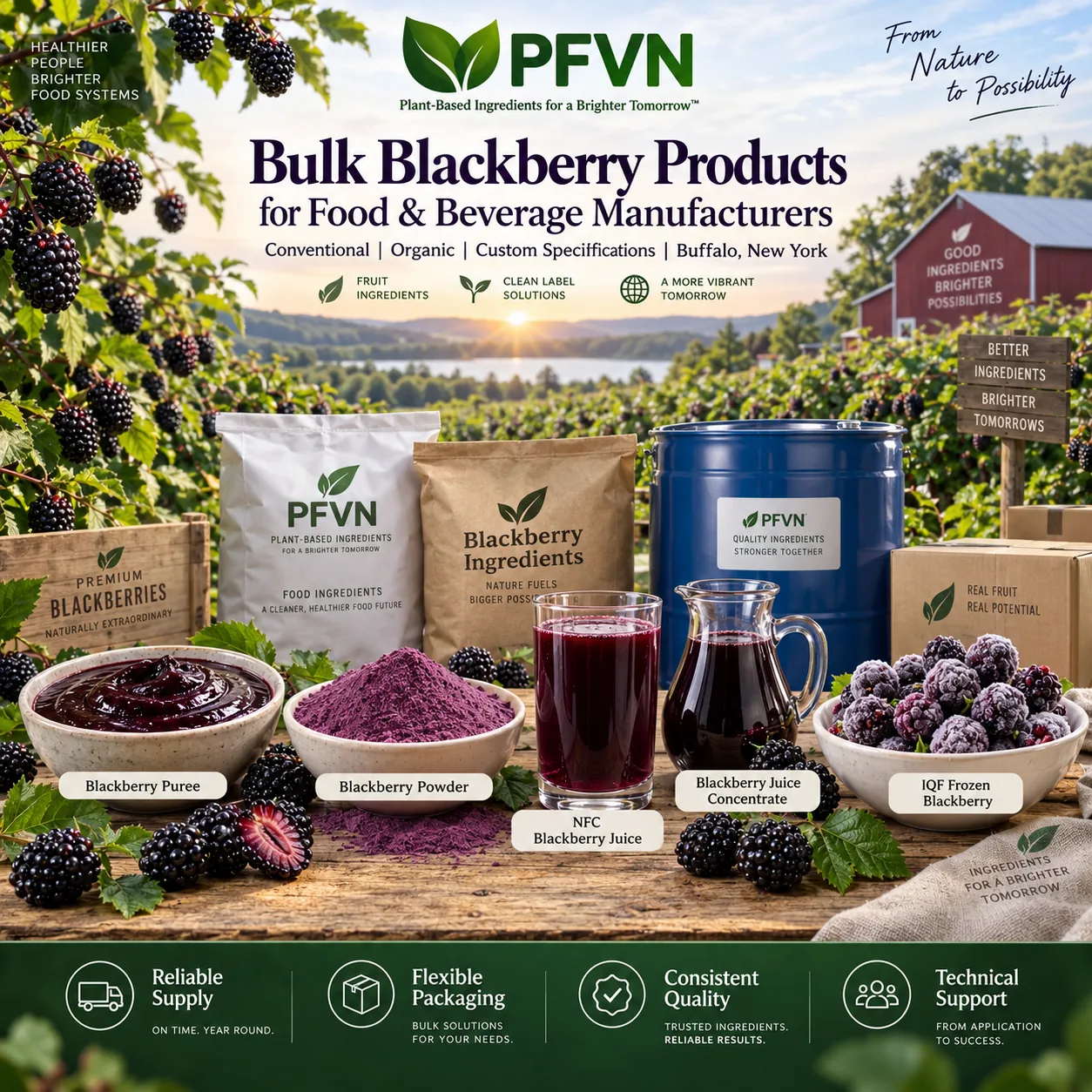
Blackberries belong to the genus Rubus and are aggregate fruits made up of numerous individual drupelets. Each drupelet contains a small seed, which makes seed content and finishing method particularly important when blackberry is processed into puree.
Fully ripe blackberries develop their characteristic dark purple-to-black appearance, sweet-tart flavor and pronounced berry aroma. Cultivar, fruit maturity, growing region and crop conditions influence soluble solids, natural acidity, pigment concentration, seed characteristics and flavor intensity.
Unlike clarified blackberry juice, puree retains suspended fruit material and pulp, giving it greater body, opacity and texture. Depending on the required application, the fruit can be finished through different screens to retain more natural texture or produce a much smoother, reduced-seed puree.
One of the most important commercial distinctions in blackberry puree is the amount of retained seed and coarse fruit material. The appropriate finish depends on the desired mouthfeel, downstream equipment and final application.
Less aggressive finishing can retain more natural blackberry particles and seed material. This style can suit rustic fruit preparations, preserves, certain bakery fillings and applications where visible fruit texture is acceptable.
Additional refining reduces coarse seed material while retaining blackberry pulp and body. It can provide a useful balance between natural fruit character and smoother eating quality.
Fine-screened puree is often preferred for beverages, yogurt preparations, frozen desserts, sauces and other products where coarse seed particles would create undesirable mouthfeel.
Terms such as “seedless” and “reduced seed” can differ between processors. Commercial approval should therefore identify the final screen opening, particle tolerance or other measurable finish specification.
Blackberry puree specifications vary with cultivar, growing region, harvest maturity and processing method. Industrial qualification normally considers soluble solids, acidity, finish, consistency, color, sensory profile and microbiological criteria together.
°Brix provides an indication of soluble-solids concentration and affects sweetness, fruit loading and formulation yield. As reference benchmarks, USDA specifications list minimum single-strength values of 10.5°Brix for Evergreen blackberry and 10.0°Brix for Marion blackberry. Actual commercial specifications should always be confirmed.
Blackberries are naturally acidic and their sugar-acid balance is central to berry flavor. USDA reference specifications list pH 3.2–4.0 for Evergreen and 2.9–3.6 for Marion blackberry puree. Titratable acidity should also be specified where flavor balance or process control is critical.
Screen size affects smoothness and retained seed material. USDA's seedless frozen-puree reference uses a final screen opening no greater than 0.033 inch, illustrating the relatively fine finishing required for smooth commercial puree.
Puree consistency influences pumping, mixing, filling and finished-product mouthfeel. When consistency is critical, buyers should define the measurement method, temperature and acceptable range rather than relying on descriptive terms such as “thick” or “smooth.”
Commercial blackberry puree should have a characteristic reddish-purple to dark-purple appearance. Cultivar, ripeness, processing severity, oxygen and storage can influence color intensity.
Qualification should confirm characteristic blackberry aroma and tart berry flavor together with absence of fermented, scorched, oxidized or otherwise objectionable sensory notes.
Specifications may establish limits for aerobic plate count, yeast and mold, coliforms and relevant pathogens. Acceptance criteria depend on processing method, packaging, storage and the finished application.
Confirm whether the material is 100% blackberry puree or contains water, sweeteners, acidulants or other ingredients. Unsweetened single-strength puree should be distinguished from formulated fruit preparations.
Blackberry's intense purple-red appearance is associated largely with anthocyanin pigments. These naturally occurring pigments provide an important visual contribution to beverages, dairy preparations, sauces and frozen desserts but can be sensitive to processing conditions.
Research on processed blackberry products shows that heat treatment and storage can reduce redness and anthocyanin content. Temperature, process time, pH, oxygen exposure and storage conditions can all influence pigment stability.
Manufacturers should therefore evaluate blackberry puree after the complete thermal process and expected storage period when finished-product color is an important commercial attribute. A puree that appears bright when received may perform differently after pasteurization, baking or extended refrigerated storage.
Blackberry puree is particularly useful where manufacturers require pronounced berry character, natural dark-fruit color, acidity and fruit body. Major applications include smoothies, beverages, dairy fruit preparations, bakery fillings, frozen desserts, jams, spreads, sauces and specialty nutrition products.
Blackberry puree contributes berry flavor, fruit solids and strong purple-red color to smoothies, fruit drinks, beverage bases and multi-fruit systems. Fine-finish puree can help reduce seed perception in drinkable products.
Application guide → Purees Baby Food & Fruit PouchesFine-finish blackberry puree can be incorporated into blended fruit pouches and puree systems where seed level, acidity, particle size and microbiological criteria meet the manufacturer's requirements.
Application guide → Dairy Fruit Preparations for YogurtBlackberry provides strong flavor and visual identity for stirred yogurt, fruit-on-the-bottom products and cultured-dairy preparations. Seed level, acidity and interaction with the dairy base should be evaluated during development.
Application guide → Bakery Bakery Fillings & InclusionsPuree can provide the fruit base for pastry fillings, cake layers, fruit pockets and other bakery systems where sugar, starch or pectin establishes the required finished texture.
Application guide → Frozen desserts Frozen Dessert ManufacturingBlackberry puree is used in sorbets, ice cream variegates, frozen fruit desserts and dessert bases where dark berry color and tart-sweet flavor remain recognizable after freezing.
Application guide → Fruit preparations Jams, Preserves & Fruit SpreadsPuree provides fruit solids, acidity, flavor and color for jams, spreads, compotes and mixed-berry preparations. Seeded or fine-finish styles can be selected according to the desired texture.
Application guide →Its strong color and sweet-tart flavor also make blackberry puree useful in adjacent food and beverage applications where a concentrated berry identity is desired.
Blackberry puree can be used in coulis, cheesecake toppings, fruit drizzles and plated-dessert sauces where strong berry flavor and color are important.
Puree can contribute berry flavor and acidity to confectionery centers, fruit gels and layered preparations used in chocolate, bakery and dessert systems.
Blackberry puree can provide recognizable fruit content and color in nutrition pouches, blended fruit products and specialty foods subject to the processing and nutritional requirements of the finished formulation.
Blackberry combines well with raspberry, blueberry, strawberry, cherry and other fruits when formulators want deeper color, pronounced acidity or a more complex berry profile.
Blackberry puree should not be evaluated solely by price per kilogram. Cultivar, fruit maturity, seed-removal level, °Brix, acidity, color intensity, processing method and packaging can materially affect performance in the finished formulation.
Evergreen and Marion are two examples of blackberry types used in commercial processing, and their reference °Brix and pH values differ. Other cultivars and origins may have their own sensory and analytical profiles. Buyers with tight flavor or acidity targets should qualify the actual source rather than treating every blackberry puree as interchangeable.
Commercial inquiries should also identify conventional or organic requirements, preferred origin, frozen or aseptic format, sample or trial quantity, expected annual demand, delivery frequency and destination.
Blackberry puree may be supplied in frozen, aseptic or other validated commercial formats depending on processor and product specification. Packaging should be matched to production batch size, warehouse conditions, thawing capacity, pumping requirements and inventory turnover.
Frozen puree requires an uninterrupted cold chain. Storage temperature, thawing procedure, acceptable thaw time and post-thaw handling should follow the supplier's current specification.
Where available, aseptic processing provides an alternative to frozen storage. Unopened storage conditions, shelf life and handling after opening should be confirmed for the exact product and package system.
Industrial receiving programs may verify lot identity, packaging integrity, net weight, product condition, temperature where applicable and required quality documentation before release to production.
Pack size should match manufacturing batch volume so opened or thawed product can be consumed efficiently within the supplier's recommended handling period.
Microbiological requirements depend on processing method, package format and end use. Commercial specifications may address aerobic plate count, yeast and mold, coliforms and relevant pathogens together with customer-specific testing requirements.
Physical criteria can include seed level, coarse particles, foreign material, color, consistency and other defects. Seed tolerance becomes particularly important in beverages, yogurt preparations and smooth desserts where coarse particles may negatively affect mouthfeel.
Because blackberry is an agricultural ingredient, some natural variation in color, °Brix and acidity is expected between crops. Defined commercial ranges help distinguish acceptable natural variation from characteristics that could materially affect the finished product.
Depending on the formulation, blackberry may also be sourced as IQF frozen fruit, juice concentrate, NFC juice or powder when a piece-form, clarified liquid, concentrated or dry-format ingredient is better suited to production.
Select package size around batch volume, storage conditions, thawing or pumping requirements, line rate and unloading equipment. Exact formats depend on the processor, preservation method and supply program.
Useful for product-development trials and smaller manufacturing runs. Depending on the source, smaller blackberry puree packs may be frozen, aseptic or supplied in another validated configuration.
A common industrial scale for aseptic or frozen fruit puree. Many programs use approximately 400–500 lb fills, although exact net weight, liner and pallet configuration vary by processor.
Potentially suitable for pumpable, higher-volume programs where the puree, processing system and filling technology support bulk tote supply. Availability should be confirmed for the specific blackberry source.
Selected puree programs may use bag-in-box, frozen block or lined-carton configurations where manageable portions and easier thawing are preferred.
Include the application, target °Brix or acidity, seeded or fine-finish requirement, sieve or particle target, conventional or organic program, estimated quantity, packaging, delivery location and timing. These details help identify an appropriate commercial source and specification.